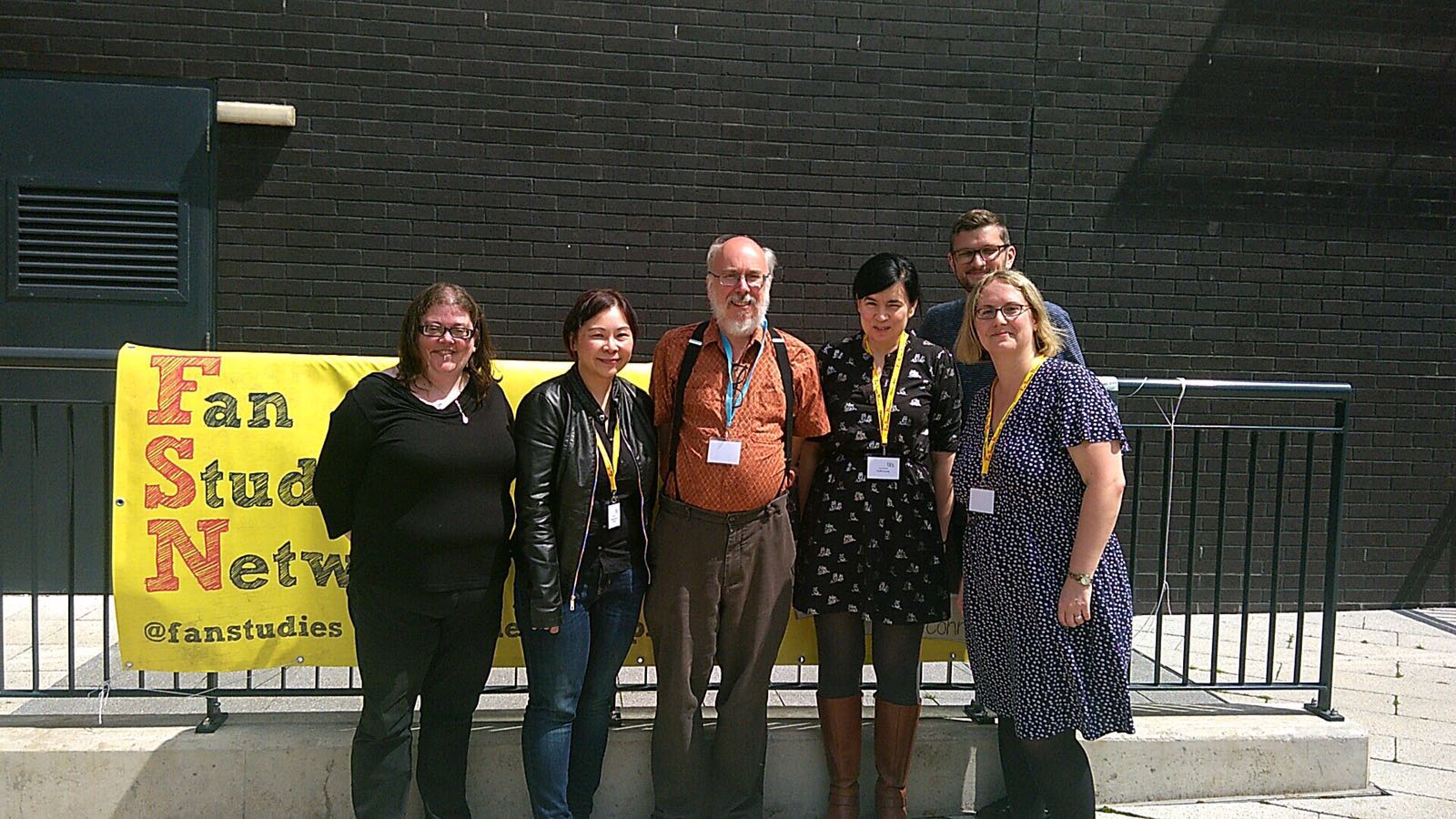
This year’s FSN saw a reporter from The Daily Fandom attending, followed by a write up about the conference.
Read about the world’s nerdiest academic conference’ here: http://thedailyfandom.com/fan-studies-network-conference/
This year’s FSN saw a reporter from The Daily Fandom attending, followed by a write up about the conference.
Read about the world’s nerdiest academic conference’ here: http://thedailyfandom.com/fan-studies-network-conference/
Australian fans have access to a wide array of popular culture content from around the world, developing relationships with these products that are as rich as fans from other parts of the globe. Until recently access to media products is limited by temporal
and spatial distance from countries of origin. Yet, at the same time practices from diaspora communities to preserve cultural identity introduces a multitude of global media content to a wider Australian audience. Australian fans thus engage with a mixture
of ‘conventional’ and ‘niche’ media products that places them both within the margins and in the mainstream. While there may be parallels between Australia and other nations with multicultural communities, the geographical location, history and cultural mix
of Australian society give rise to unique contexts shaping the consumption and practices of Australian fans.
We thus ask the question: What makes the Australian fan experience unique? What influence does geo-political location have on the consumption and appropriation of popular culture in the Australian context? What impact does Australian multicultural society
have on exposure and access to popular culture? What drives Australian fan interaction with global popular culture, and how does this interaction intersect with narratives of ‘Australian-ness’ in local and globalised contexts?
This book seeks to explore the specific and unique experience of being fans living and Australia.
We seek authors to contribute critical chapters for an edited volume to be submitted to University of Iowa Press. Topics include but are not limited to:
Please email 300 word abstracts and your
CV to both Celia Lam and Jackie Raphael by
August 31 2016. Proposals should be for original chapters that have not been previously published (including conference proceedings), and are not under consideration from other journals or edited collections.
Dr. Celia Lam is Lecturer in Media and Communications, School of Arts and Sciences, University of Notre Dame Australia, Sydney (celia.lam@nd.edu.au)
Dr. Jackie Raphael is Lecturer in Design, School of Design and Art, Curtin University (J.Raphael@curtin.edu.au)
Adventures in Shondaland: Identity Politics and the Power of Representation
Editors: Rachel Alicia Griffin, Ph.D., University of Utah
Michaela D.E. Meyer, Ph.D., Christopher Newport University
At this time, we have 12 confirmed and drafted chapters for our collection. Due to unforeseen circumstances, a few spaces have become available
for additional chapters. As described in our original call below, our collection is framed by three sections pertaining to Shondaland: (1) Industry, (2) Text, and (3) Audience. To compliment the strong chapters we currently have in each section, we are specifically
seeking out proposals that address:
Identity Politics (especially ability, religion, and/or nationality)
Audiences (reactions, interpretations, engagement, communication and relationships with Rhimes herself and/or Shondaland actors,
e.g., Jesse Williams via Twitter and BET)
Private Practice
The Catch
Social justice and activism
Social media activism
Proposals are due by Monday August 1st 2016 and accepted proposals will be notified
soon after. The anticipated deadline for full chapter drafts ismid to late fall, so authors who are able to make their chapter a priority in the near future or who have projects already in progress are likely the best fit for this call. Please follow
the guidelines below outlined in our original call for proposal requirements, and send proposals to
rachelag@siu.edu by
Monday August 1st 2016 with “SHONDALAND” in the subject line.
ORIGINAL CALL:
Communication approaches to the study of television tend to be constrained by arbitrary divisions between text, audience, and production, and thus,
we often limit our engagement with the interrelationship between textual representation (rhetorical approaches), audience interpretation (cultural studies approaches), and production strategies (industry perspectives). Building upon recent works that blur
the distinctions between text, audience, and production (e.g., Holmes, 2004; Meyer, 2007; Watts & Orbe, 2002; H. Wood, 2005) to further theorize the communicative function of television, communication scholarship needs to integrate its approach to contemporary
television studies.
This edited collection aims to bridge these divides by focusing on the television legacy of Shonda Rhimes. Rhimes is the creator and/or producer
of Grey’s Anatomy (2005-), Private Practice (2007-2013), Scandal
(2012-), How to Get Away with Murder (2014-), and, most recently, The Catch (2015-2016 season pilot debut). Her narratives capture large audiences in coveted primetime slots and continue to be highly economically successful. As the most powerful
Black woman in the history of network television, Rhimes’ primetime network influence via ABC shapes the landscape of how we understand television representation, interpretation, and production in the 21st century. Simultaneously, as an influential
public figure, her success, candor, humility, and intentionality significantly shapes discussions of identity/ies and diversity in current network television. Further indicative of Rhimes’ presence/audibility/visibility/influence in public discourse, @shondarimes
boasts 961K followers, and her tweets often address identity politics and the power of representation. This influence is not limited to Rhimes herself, as the fans, actors, and writers working with/following Rhimes also contribute heavily to our public understanding
of what is at stake in current television narrative and practices.
Our goal in this collection is to offer a complex reading of “Shondaland” by interrogating: representation, audience responses to Rhimes’ narratives/public
discourse, and larger industry issues such as casting and the emergence of new media technologies.
We are currently seeking proposals to augment our collection that address the following topics:
Complex textual readings of any of Rhimes’ narratives (listed above).
Audience-centered approaches to Rhimes’ work such as focus groups, interviews, autoethnography, or analysis of fan discussion/response to particular narratives/storylines/characters.
Cultural critique of industry norms and practices that influence Rhimes’ work such as representation, casting, writing, and/or industry scandal (e.g., Washington/Knight scandal
on Grey’s, the use of Rhimes as an “all encompassing” spokesperson for diversity on television, etc.).
We are
especially interested in proposals that embrace audience-centered approaches, critique industry practices and political economy, and analyze identity politics that include a focus on ability, age, transgender and gender queer identity, nationality, religion,
and racial and ethnic identities beyond the Black/White binary.
Proposals should operate theoretically and methodologically from critical approaches to the study of television.
Via a 500-750 word abstract, each proposal should make clear: (1) the chapter’s purpose framed in relation to the call,
(2) how the chapter is theoretically/conceptually and methodologically anchored,
(3) the chapter’s primary text(s)/trajectory for analysis/argument, (4)
the scholarly conversations the chapter is contributing to, and (5) the provocative questions raised and/or addressed by the chapter. Proposals should also include a bibliography of at least 15 working sources for the chapter proposed, as well as
a brief biography for each author (150 words or less). Proposals are limited to a 1500 word maximum (not counting the bibliography and bios).
Overall, for our planning purposes, each abstract should include an explicit indication of the chapter’s focus
on text and/or audience and/or production. Although we embrace the distinctions between text, audience, and production, we also see these as fluid and simply need to know which elements will be emphasized in the chapter.
Inquiries about the call or this project can be directed to either of the editors: Rachel Alicia Griffin (rachelag@siu.edu)
or Michaela D.E. Meyer (mmeyer@cnu.edu ).Please
include “SHONDALAND” in the subject line of all correspondence with the editors.
The extreme profitability of Mel Gibson’s
The Passion of the Christ in 2004 came as a great surprise to the Hollywood establishment, particularly considering its failure to find production funding through a major studio. Since this time, the big-budget mainstream biblical epic, long thought dead in terms of widespread marketability, has become a viable Hollywood studio product with regards to seeking both profits and critical acclaim, as well as outlets for auteurist ‘passion projects’ such as Gibson’s film, Darren Aronofsky’s Noah (2014), and Ridley Scott’s Exodus: Gods and Kings. With this year seeing two new fiction films featuring depictions of Jesus, the crucifixion, and resurrection [Risen (dir. Kevin Reynolds) and Ben-Hur (dir. Timur Bekmambetov)], academic consideration of the modern biblical epic is both timely and highly relevant.
This is a preliminary call for papers and proposals for an edited collection using a broad range of approaches in the analysis of these films and this phenomenon specifically. Proposals can address, but are not limited
to:
Stylistic and narrative analysis
Considerations of genre
Historical and political contexts
Industrial efforts to capitalise on this trend (see the short-lived Fox Faith studios in the mid 2000s and its products)
Critical viability and acceptance
Intersections of, or discord between, faith and fandom
Representations of race and gender
Auteurist analyses of these films
Philosophical and more broadly theoretical approaches to these films and this trend.
Proposals and abstracts of approximately 300 words with a short bio can be submitted to Wickham Clayton by 31 August, at wickscripts@hotmail.com. Also feel free to email for expressions of interest and questions regarding the project.
CFP: Tolkien and Jackson Fan Studies Special Issue (10-01-16)
Proposals are sought for fan studies scholarship on any aspect of fan production, creation, or activities relating to J. R. R. Tolkien’s Legendarium and/or Peter Jackson’s live-action film adaptations of The Lord of the Rings and The Hobbit.
The editors hope to co-sponsor at least one dedicated paper session at the national Popular Culture Conference (San Diego, April, 2017), and then to develop those papers to submit to a special theme issue of Journal of Tolkien Research the same year.
NOTE: There is no requirement that scholars must present at the Popular Culture conference in order to submit proposals to the journal, nor does participation at PCA mandate submitting to the journal issue.
However, this option, we believe, will allow for multi-disciplinary dialogue among and between scholars in the preparatory stages of thinking about the special issue.
JTR is an open-access, electronic, peer-reviewed journal:
http://scholar.valpo.edu/journaloftolkienresearch/
Timeline:
Popular Culture Submissions: July 1-October 1, 2016
Popular Culture Conference: April 12-15th, 2017
Deadline for submission to editors: June 1, 2017 (Proposal or First Drafts)
Deadline for submission to JTR: September 30, 2017 (Final Drafts)
Co-editors:
Katherine Larsen klarsen@gwu.edu
Robin Anne Reid robin.reid@tamuc.edu
CFP: Monstrous Women in Comics—an Interdisciplinary Conference on Women in Comics and Graphic Novels
May 2017, University of North Texas, Denton, TX
Keynote: Dr. Carol Tilley, Associate Professor, Graduate School of Library and Information Sciences, University of Illinois at Urbana-Champaign
The relationship between women and the comics industry is contested perhaps now more than ever before. Fresh conflicts in mainstream presses reveal lingering aversions to women creators, and fan-reactions to reboots demonstrate similar dis-ease with “non-canonical” re-imaginings of female characters. Far from being novel, these tensions are rooted in the very history of western comics. From the Golden Age, women were erased or marginalized in comics through, for instance, the use of “gender-neutral” monikers. Female characters were aesthetically constructed to meet and satisfy the male gaze and overwhelmingly, their narratives were penned by male authors. Women readers of comics were historically “pandered to” with romance comics but were otherwise ignored as a target audience. Even within the medium of graphic novels, where women’s work has arguably been more visible, women creators are being erased by industry-standard events like the Angoulême Festival. Here, as in other areas of popular culture, women are treated in very Aristotelian ways—at best, they are deemed to be monstrous derivatives of men, and at worst, they are simply monsters for daring to enter what has been overwhelmingly characterized as man’s domain. From a feminist perspective, there is ample room for critique of the ways in which women in comics are made into monsters, but now we want to ask if that is all there is? Must a theoretical investigation of monstrous women in comics be limited to surveys of marginalization and erasure?
Building on the work of postmodern scholars like Donna Haraway, and following from recent iterations of Monster Studies, we seek to critically engage with, and re-evaluate, monstrous women in comics. For Haraway, the figure of the monster is one who simultaneously illuminates and threatens boundaries; the monster is a creature who resides in borderlands and embodies transgression; she is the imbrication of text, myth, body, nature and the political—she is neither “self” nor “other.” To be deemed monstrous is to be situated in the margins, to be placed outside, and yet the monster is one who always threatens those margins, who promises to leak into and over. Constructively engaging with the monstrous can ultimately lead us into an “imagined elsewhere,” the monster can be full of promises. Therefore, we are seeking interdisciplinary examinations of monstrous women in comics not only in order to critically question and contest normative boundaries, but also to begin to imagine how the relationship between women and comics might be otherwise.
We invite all interested participants to join us in thinking about monstrous women in comics across genres: papers may engage with historical studies of women in comics, mainstream comics, graphic novels, indie comics, religious comics, or web comics. Paper proposals, in the form of 250-word abstracts, may also address—but are not limited to—any of the following topics:
In order to further emphasize the fruitfulness of transgressing boundaries and engaging with the monstrous, this conference also seeks to leak over the boundaries of academia by inviting women comics creators who would like to submit their work for a temporary gallery exhibition and/or who would be interested in tabling the event. All interested creators/vendors should email a short bio and any relevant links to portfolios or previous works.
Accepted participants will be invited to present their 20-minute papers, or to exhibit their work, at a two-and-a-half-day interdisciplinary conference at the University of North Texas in Denton. To submit a paper proposal, or to express interest in exhibiting/tabling, please send an email tomonstrouswomen@gmail.com with the following information:
Proposals related to the podcast Welcome to Night Vale are solicited for chapter contributions to an edited scholarly collection to be published by Palgrave.
The editor seeks to include a range of approaches focusing on both form and content. Topics may include but are not limited to:
• internal themes and allusions
• genre and influences
• performance, music, and effects
• politics and historical contextualization
• podcast production, distribution, and consumption
• reception and fandom
• paratexts, marketing, and merchandise
250-word proposals and abbreviated CV indicating academic position and publications due by June 15th, 2016.
5000-word chapters due by February 15th, 2017.
Inquires and proposals to Jeffrey Andrew Weinstock at Jeffrey.Weinstock[at]cmich.edu
ASEASUK 2016 (16-18 September 2016) at SOAS London
The title of our panel is “Politics of Tastes in Southeast Asian Cinema”
Abstract: https://www.soas.ac.uk/cseas/aseasuk-conference-2016/file109439.pdf and we are looking for another 3-4 panelists and/or a chair.
If you have a paper related to our panel proposal, please consider to submit to our panel.
Alternatively, if you have an idea but not suitable with our panel proposal, probably you can consider joining a more general panel: Emerging trends in SEA Literature and Screen Cultures.
Click to access file109440.pdf
The deadline is 30 March.
Theorising the Popular
Liverpool Hope University
June 28th-29th 2016
The Popular Culture research group at Liverpool Hope University welcome papers from academics and graduate students for its sixth annual international conference, ‘Theorising the Popular’. Its aim is to demonstrate the intellectual originality, depth and breadth of ‘popular’ disciplines, as well as their academic relationship with and within ‘traditional’ subjects. The group breaks down disciplinary barriers and challenges academic hierarchies.
We would especially welcome papers in the following areas, although we invite proposals from all disciplines. As well as papers from established and early career academics, we encourage proposals from graduate students:
• Film
• TV
• Music
• Drama & Participation
• Gender:Feminism/Femininities/Masculinities/Queering/Sexualities/Representations of the Body
• Literature/Fiction
• Language/Linguistics
• Fan Cultures
• Comedy
• Politics
• Sport
• Media/Communications
• Business Studies
Papers should be 20 minutes in length. Please send abstracts of 300 words to Dr Jacqui Miller millerj@hope.ac.uk by Thursday 31st March, 2016.
Connect with us on social media:
Facebook: Theorising the Popular Conference
Twitter: @TheorisePopular
CALL FOR PAPERS — DEADLINE JANUARY 30, 2016
CONSOLE-ING PASSIONS
International Conference on Television, Video, Audio, New Media, and Feminism
June 16-18, 2016
University of Notre Dame
Notre Dame, Indiana
Console-ing Passions was founded in 1989 by a group of feminist media scholars and artists looking to create a space to present work and foster scholarship on issues of television, culture, and identity, with an emphasis on gender and sexuality. The first Console-ing Passions conference was held at the University of Iowa in 1992. Since then, Console-ing Passions has expanded to become not only the most important conference for scholars studying gender in television but also among the top conferences for scholars of media generally.
The 2016 Conference Organizing Committee invites proposals for individual papers, pre-constituted panels, and pre-constituted forums that consider television, video, audio, or new media alongside gender, sexuality, race, or other intersected components of identity. We also welcome proposals for video, audio, or new media creative works related to gender and other modes of identity.
Possible paper, panel, and forum topics include:
● media production and industries
● media audiences and fans
● textual analysis and criticism
● media theory
● feminist, queer, and critical race theory
● media history
● neoliberalism and the economy
● transmedia and convergence culture
● globalism and transnational cultural flows
● theories of post-television
● social media and the Internet
● music and sound studies
● gaming and virtual worlds
● social movements and media activism
● politics and gender
● religion and media
● youth culture and media
Submission Guidelines
The deadline for submissions is 11:59 PM (US Eastern Daylight Time) on Saturday, January 30, 2016.
Please submit your proposal here: https://console-ingpassions.submittable.com/submit
Proposers may propose only one paper or creative project, and only one CP Forum. Attendees may present only one paper or creative project, and may participate in only one CP Forum.
Individual Papers: Individuals submitting paper proposals should provide an abstract of 250 words, a short bio, and contact information. Co-authored papers are acceptable.
Panels: Panel coordinators should submit a 250-word rationale for the pre-constituted panel as a whole. Coordinators should submit a 250-word abstract, a short bio, and contact information for each panel participant. Panels should include 3-4 papers. Co-authored papers are acceptable. Panels that include a diversity of panelist affiliations and experience levels are strongly encouraged.
CP Forums: Building upon the success of discussion-based roundtables at Flow and other conferences, we invite proposals for a limited number of pre-constituted roundtables that focus either on scholarly topics in the field or matters of professional interest. We are especially interested in roundtables that are likely to engage wide participation by conference attendees, and which reflect our field’s diversity of cultural identities, institutions, methodologies, and professional rank or employment status. Proposals should be submitted by a convener, who will propose a question (<100 words) and solicit brief (<250 words) responses from 5-7 respondents. Proposals should also include a brief bio and contact information for the convener and each participant. If the proposal is accepted, each participant will write a response to the question of no more than 600 words, which must be submitted to the conference organizers 2 weeks prior to the conference. Those papers will be circulated to all attendees and will form the basis of a public discussion during the CP Forum sessions. Roundtable participants’ remarks at the conference should be brief in order to create substantive discussion with attendees.
Creative Works: We invite proposals for video, audio, or new media screenings or exhibits. Proposals should consist of a 350-word abstract (including the length and format of the work), a short bio of the producer/director, and contact information. If the work is viewable online, please submit a URL.
Please direct any questions about the conference and the submission process to:cpatnd2016@gmail.com.
Visit our website http://www.console-ingpassions.org/conf-nd/ for updates about events, schedules, travel information, and more.
Conference Organizers: Christine Becker, Michael Kackman, Mary Celeste Kearney, Susan Ohmer, and Pamela Robertson Wojcik / Department of Film, Television, & Theatre / University of Notre Dame.

